WILDFRUIT STUDIOS / DEV BLOG / THORNCOURT

The Thorncourt
Dev Blog.

Welcome to the garden! Thorncourt is the first game from Wildfruit Studios: a cozy, turn-based card strategy game played on a living 3-by-5 garden board, where you spread roots, claim ground and win lanes on your way to the throne of Thorncourt.

This is where we share how it's growing, from the very first rules we wrote down to the art, music, characters and little touches we're adding today. Grab a cup of tea, pull up a chair, and come see how a small idea became a whole court.

← All dev blogs

DEVLOG #09 ·

Knocking on the Door of Steam
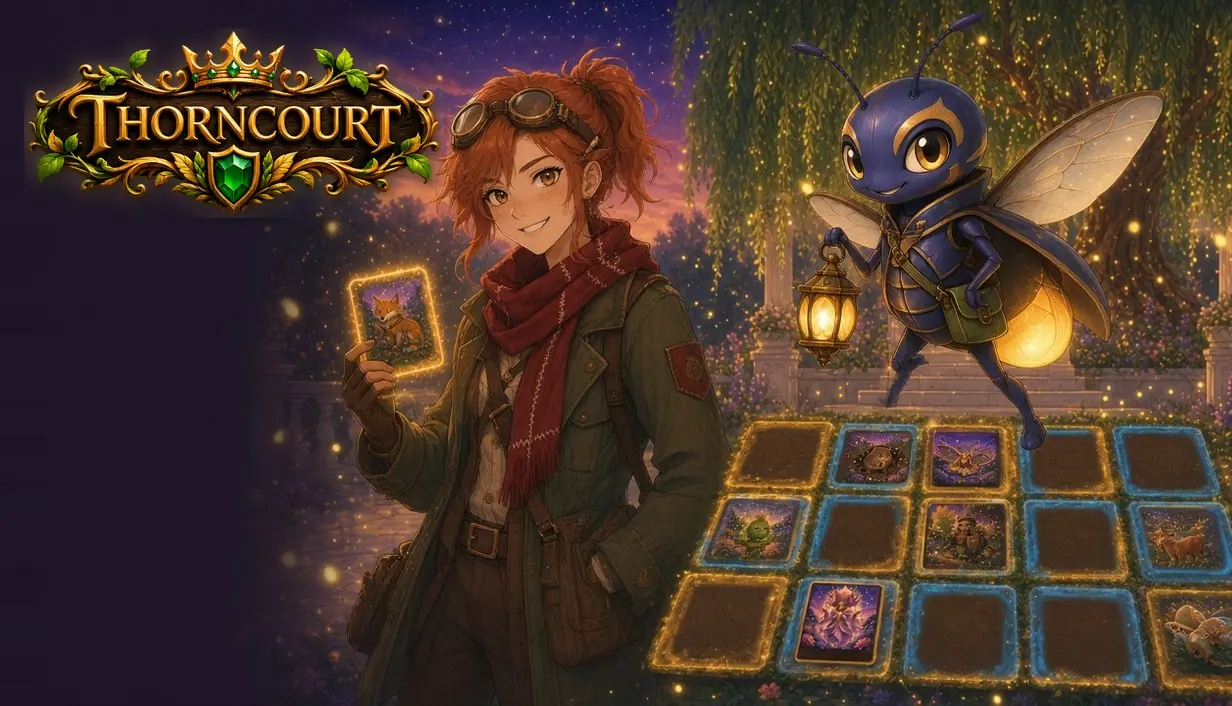
Thorncourt key art: Wren, Wick and the garden board.

With so much of the game in place, our attention turned to getting Thorncourt into players' hands.

First, the demo. We wanted it to be the perfect first taste: Wick's tutorial plus solo matches against the computer, so you can learn the garden and see if it clicks. The Career, the story scenes, local versus and online play are saved for the full game, behind a friendly screen that explains what's waiting there. Our first demo build came together on November 12.

Next, the art that will greet people on the store. Our key art shows Wren with a glowing card in hand and Wick at her shoulder, his lantern lighting up the garden board, beneath a brand-new gold-and-emerald Thorncourt logo crowned with leaves. We also painted the courtyard and its great willow for the library background, and spent a happy afternoon capturing screenshots from all over the game.

We gave the economy a careful pass so the climb feels rewarding: bigger rewards for a first win over each cup boss, and rebalanced prices for card styles. A play-time counter and tidier profile management rounded things out.

On November 16 we completed our Steamworks sign-up as Wildfruit Studios, a big moment for a small team. Steam is now verifying our details, which can take several weeks, and once that's done we can open our Coming Soon page and you'll be able to wishlist Thorncourt. We're aiming to be ready in time for Steam Next Fest in February 2027, so you can try the demo there.

While we wait, we're continuing to test online matches with friends through Steam (online play is for two players) and full gamepad play, so you can enjoy Thorncourt from the couch. We'll share more as soon as the doors open.

Thank you for following along with our first game. We can't wait to see you in Greenmantle, and maybe at the throne.
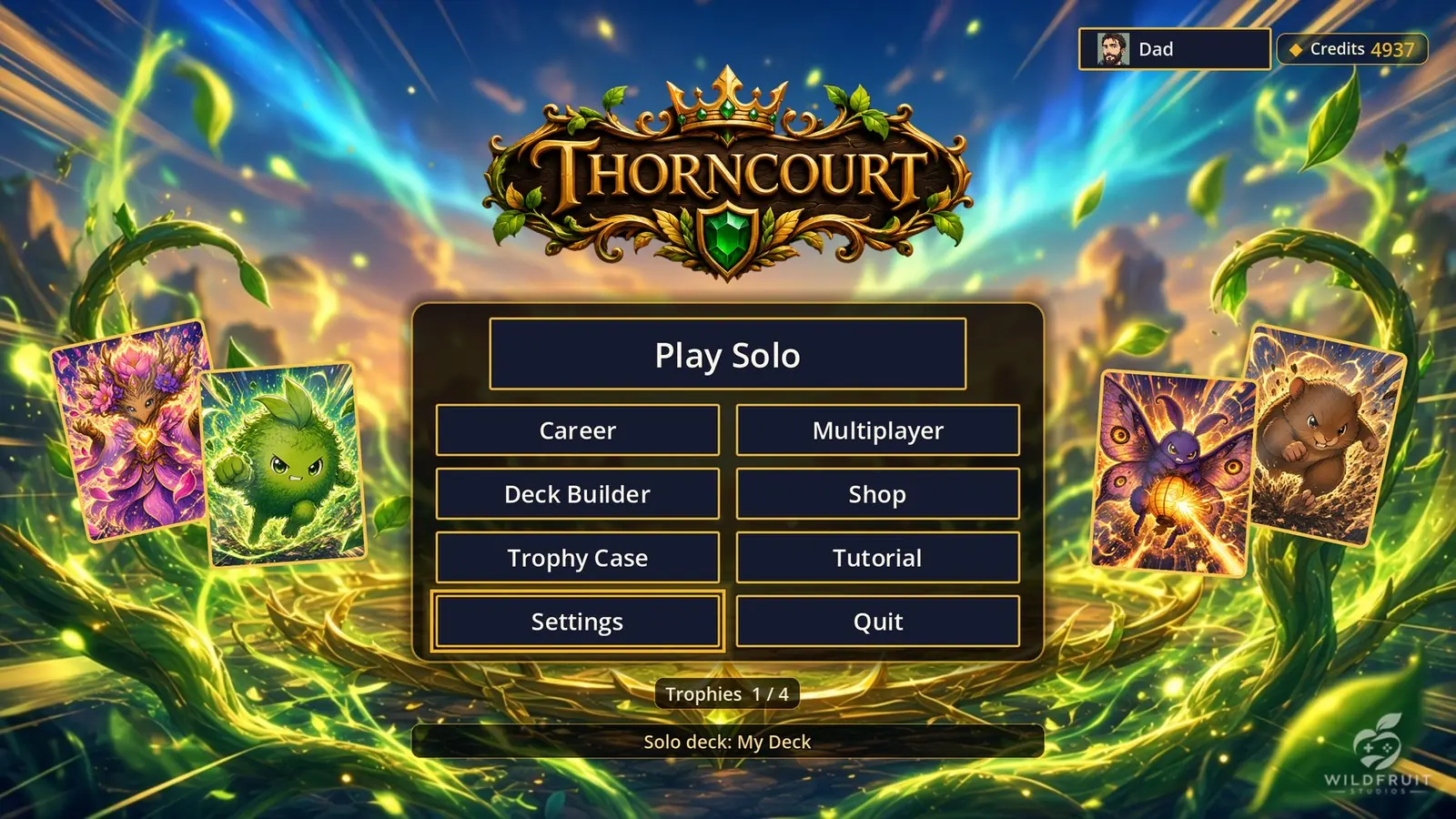

The Thorncourt title screen today.

Link to this post #Back to top ↑

DEVLOG #08 ·

New Looks for Every Table

Clover Fox in the Chibi, Papercraft and Stained Glass styles.

If you've been following along, you know we can't resist a new art style, and this stretch brought three of our favorites.

Chibi is a pastel, candy-sticker style full of round cheeks, sparkles and hearts. We made sure it looks clearly different from the default Cozy art, so it feels like a real treat to unlock. Papercraft rebuilds every creature from layered, textured paper with soft shadows. Stained Glass sets each card in gold leading and jewel colors, and comes with its own navy, gold and violet menu theme. Each of these is a full 46-card set.

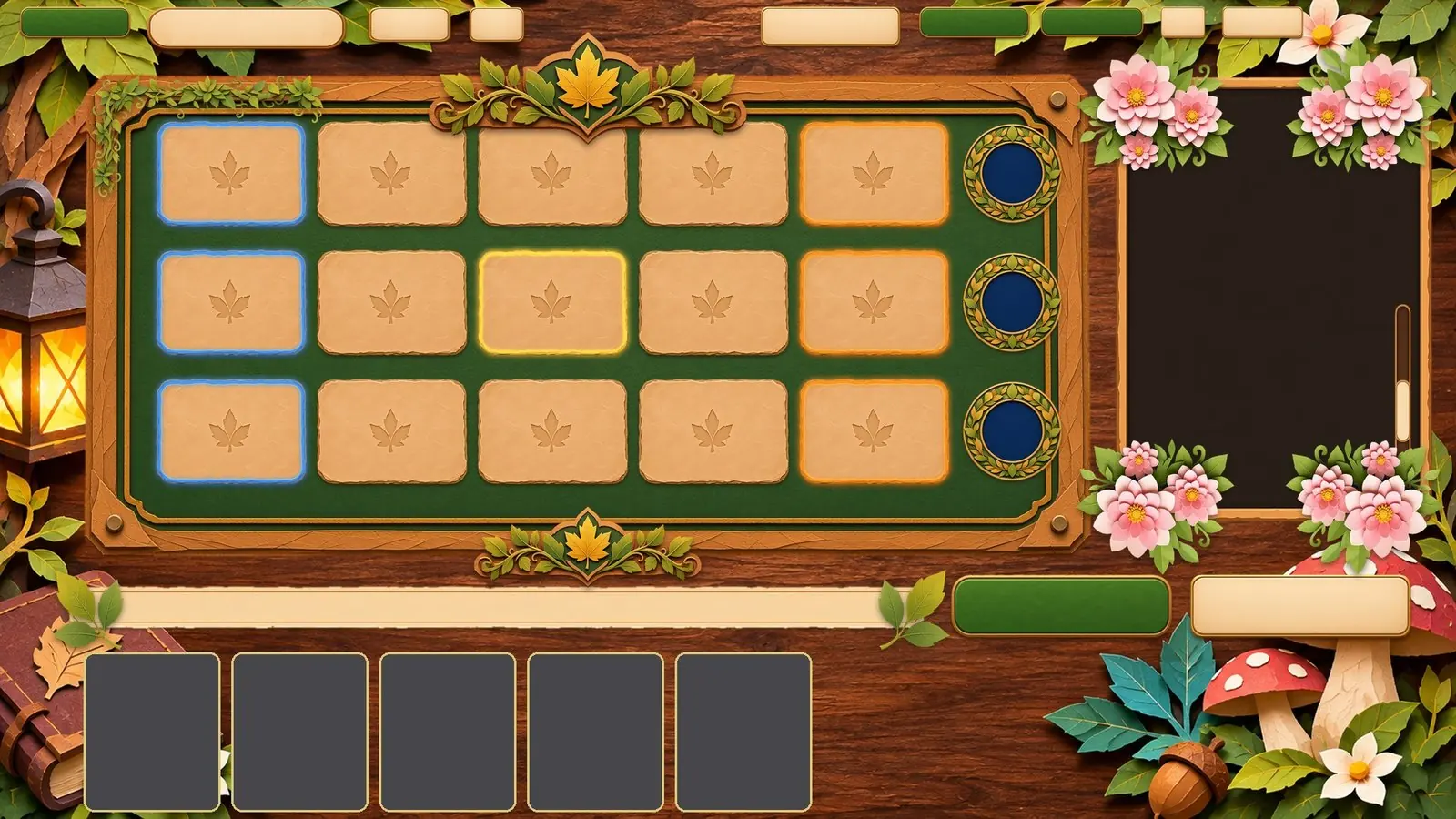
Then we turned to the table itself. Board design is now a choice you make in the Deck Builder or in Settings. Cozy is the familiar garden board. Papercraft has painted depth, with torn-paper tile edges, a carved wooden frame wrapped in vines and a leaf crest, wreathed medallions and a flowered side panel. Obsidian is our premium board: clean and symmetrical, with black marble tiles, gold frames, emerald gems and a velvet drape, for when you want your matches to feel a little grand. The shop can also wear the Papercraft look, from Marigold's main counter to every stall.

The Circuit got some love as well. We refreshed the career screens so each cup's venue sits softly behind the board while you keep your chosen board design, and we redrew the match buttons so they stay crisp and properly proportioned at any size. Lots of tiny fixes went in along the way, like matching scrollbars and a cleaner credits display.

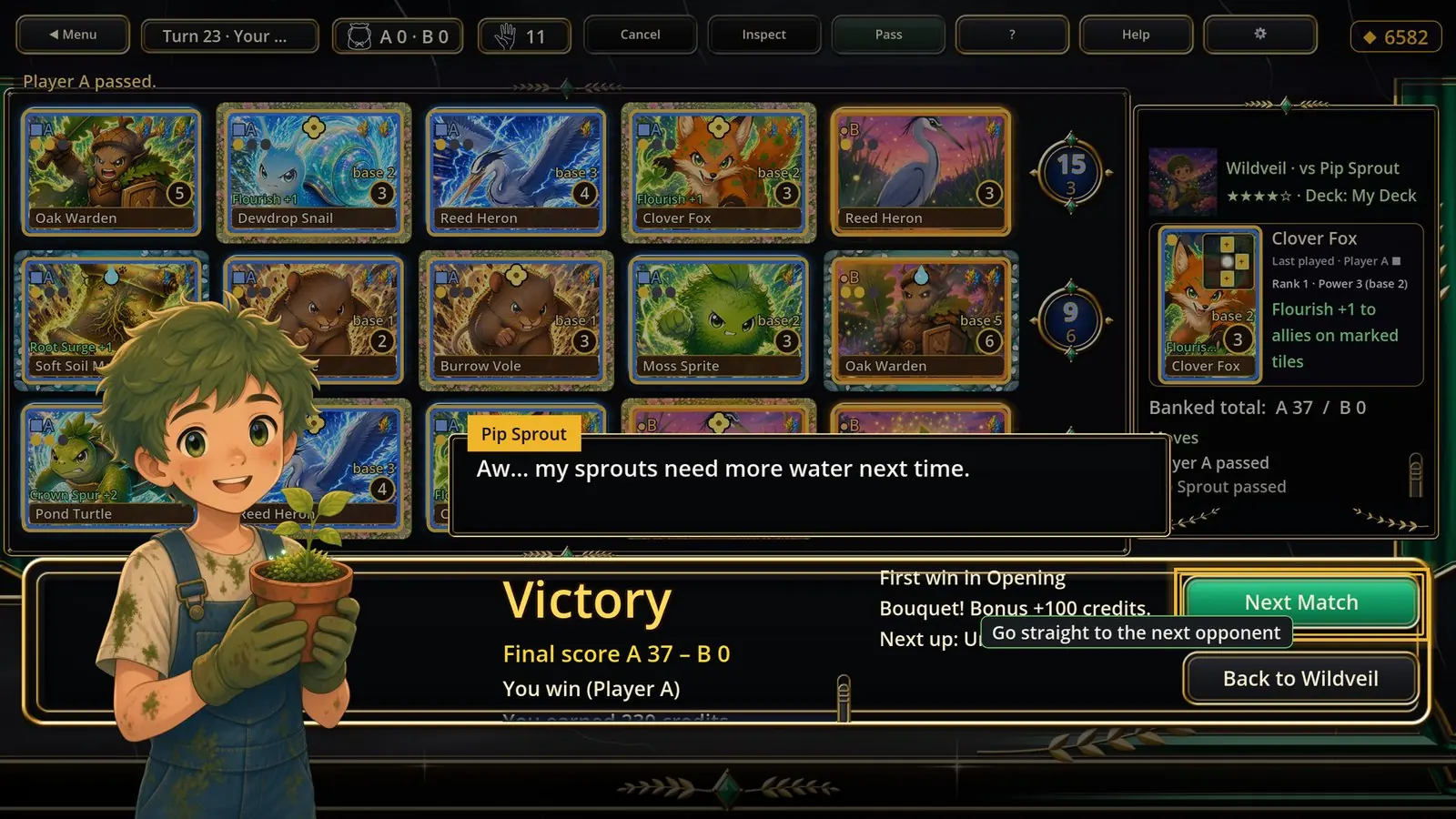
We also smoothed out what happens after a match. Win, and a Next Match button takes you straight to your next opponent. If that win finishes a cup, Continue carries you onward. A rematch option appears after a loss or a draw, and Back to Career is always there if you need a breather.

The Obsidian board: black marble, gold and emerald.
A preview of the Papercraft board design.

Link to this post #Back to top ↑

DEVLOG #07 ·

The Wildveil Invitational

Pip Sprout welcomes you to the Wildveil Invitational.

What happens after you've beaten Elder Willow? We wanted champions to have somewhere new to go, so we planted a postgame tournament: the Wildveil Invitational.

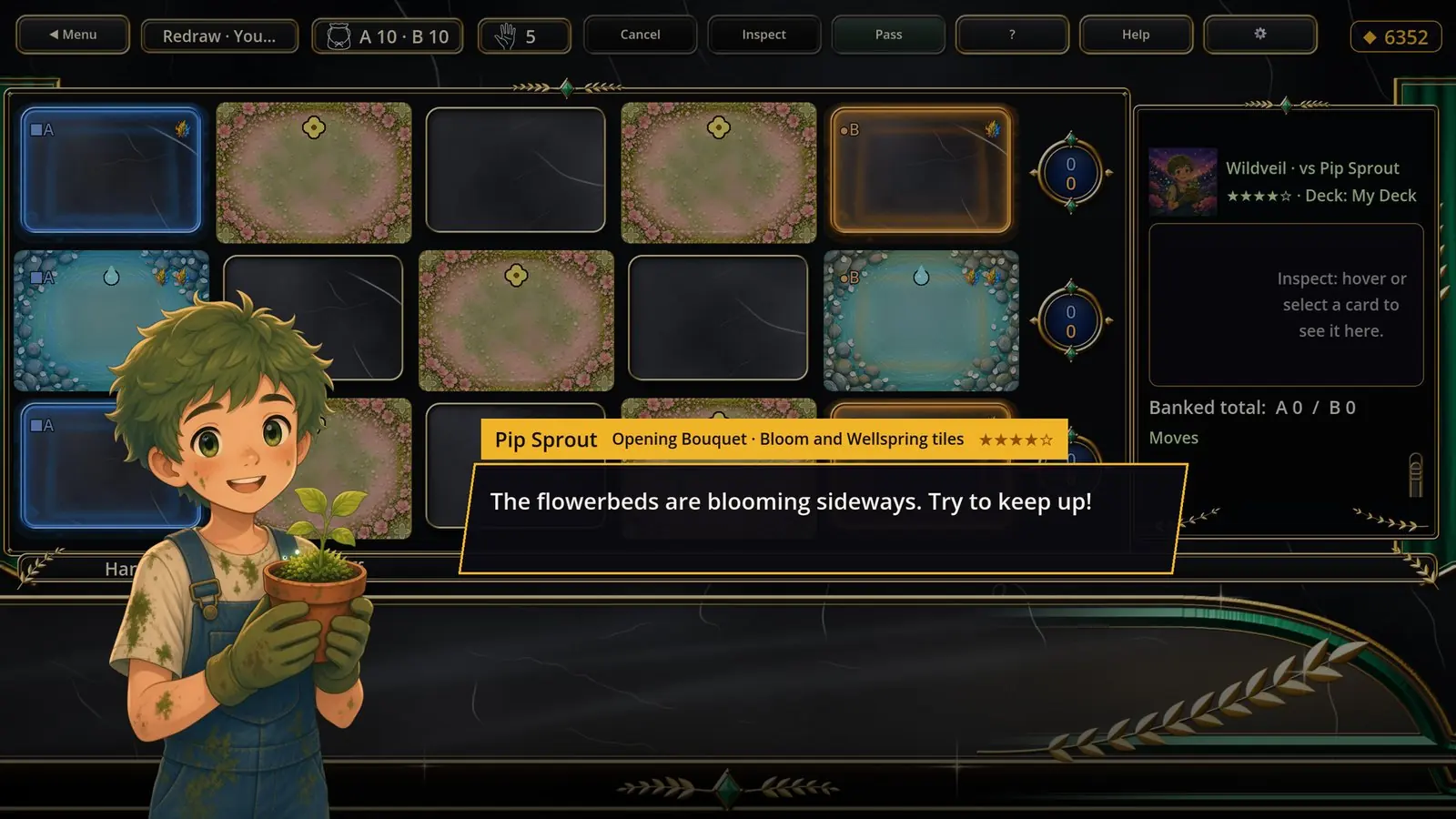
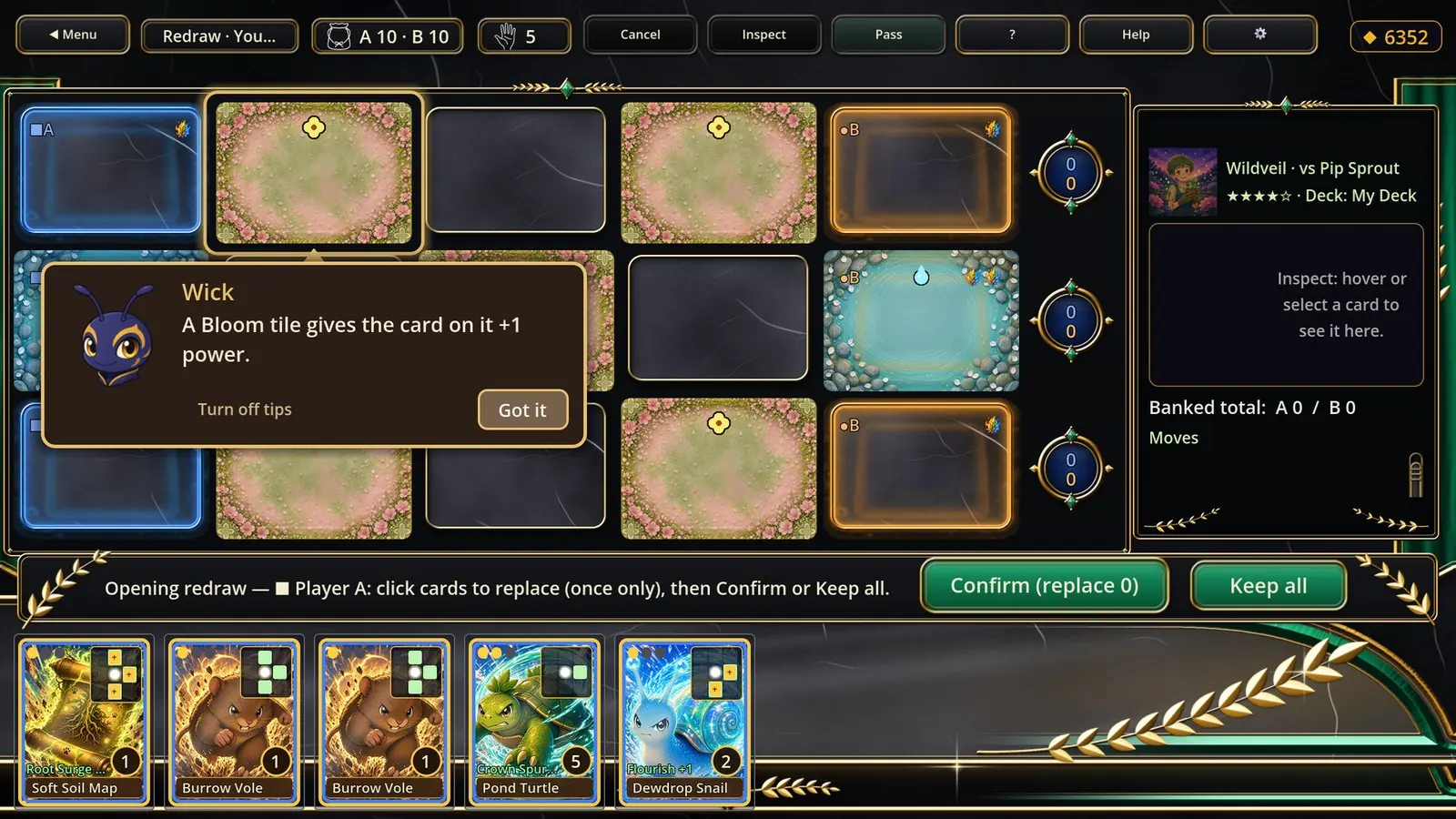
The four Circuit cups stay exactly as they are, on the classic garden board. Wildveil is where the board itself starts to misbehave, in the nicest possible way. Every match uses special tiles. A Bloom tile gives the card planted on it +1 power. A Thorn tile takes 1 power away. A Wellspring tile starts with an extra root, so you can play stronger cards there sooner. Some matches add a venue-style rule on top, like greenhouse growth, hedges that stay hidden until you reach them, or a mixed finale that brings it all together.

Old friends come back for it too. In one early event, Pip Sprout's Opening Bouquet, the flowerbeds really do bloom sideways. Wick is on hand with tips the first time you meet each new tile, the computer opponents understand the tiles just as well as you do, and new pages in the rules guide explain everything.

Mid-November was also a great week for polish. Thorncourt got its menu music: one calm, lo-fi tune that plays continuously across the title screen, deck builder, shop, settings and map, without restarting every time you change screens. The music only changes when you head into a match, a story scene or the Wildveil Invitational, with a soft crossfade.

We also gave the computer opponent a bit more personality. Instead of answering instantly, it now takes a short moment to "think," shown with a little Wick badge, so matches feel more like sitting across from a real player. If you'd rather keep things brisk, a new Opponent speed setting lets you choose. And for anyone who loves capturing a great board, there's now a screenshot key.

A Wildveil victory on the special-tile board.

Link to this post #Back to top ↑

DEVLOG #06 ·

Welcome to Petal & Pocket

Marigold Sprout behind the counter at Petal & Pocket.

Up to now, the shop was a tidy list of cards and prices. It worked, but it didn't feel like Greenmantle. So we turned it into somewhere you actually visit.

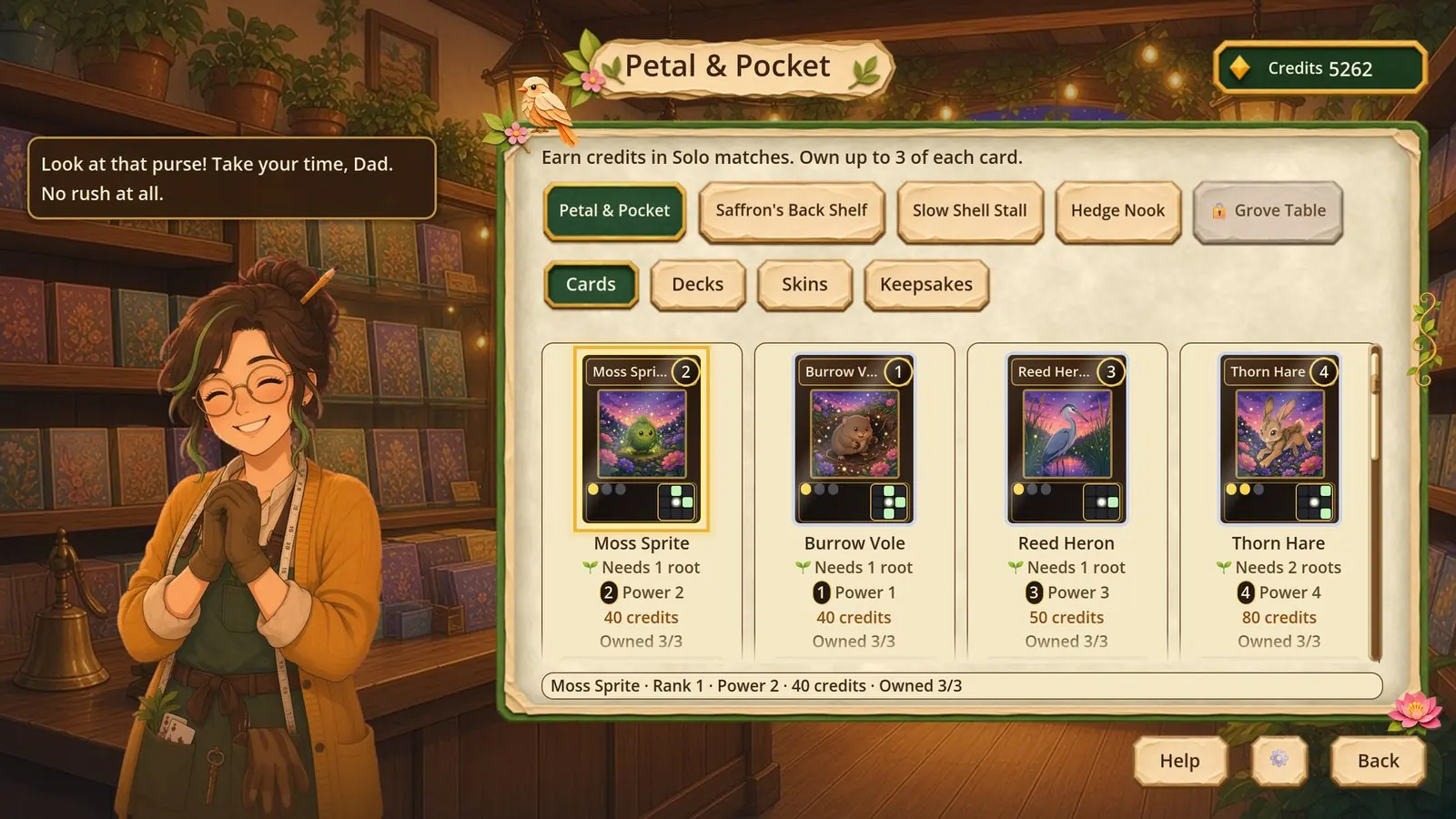
Petal & Pocket, the cozy card shop where your career begins, is now the game's home shop. When you walk in, you're greeted by its owner, Marigold Sprout. She's Pip's mom, she wears a big mustard cardigan and a tape measure around her neck, and she always has a kind word, whether you're splurging on a new set or just browsing. She has her own expressions too: welcoming, happy, thoughtful, a little apologetic, and a wink when she's especially pleased.

Inside you'll find shelves for Cards, Decks, Skins and Keepsakes. Ready-made deck bundles are a nice shortcut for anyone who wants to try a new strategy without building from scratch.

As you climb the Circuit, the shop grows with you. Beating each cup's boss opens a new stall with its own stock, set in that cup's venue: Saffron's Back Shelf, the Slow Shell Stall in the conservatory, the Hedge Nook tucked into the maze, and finally the Grove Table up at the Thorncourt. It's a small reward for progress that makes the city feel alive.

We were careful that none of this changed what players already owned. Every price, credit, skin and saved collection carried over just as it was. And because Thorncourt is built for playing on the couch, the whole shop works with a mouse, a keyboard or a gamepad.

One promise we made early still stands: credits are earned by playing, never bought with real money. There are no card packs for cash and no ads, just you, your deck, and a friendly shopkeeper.

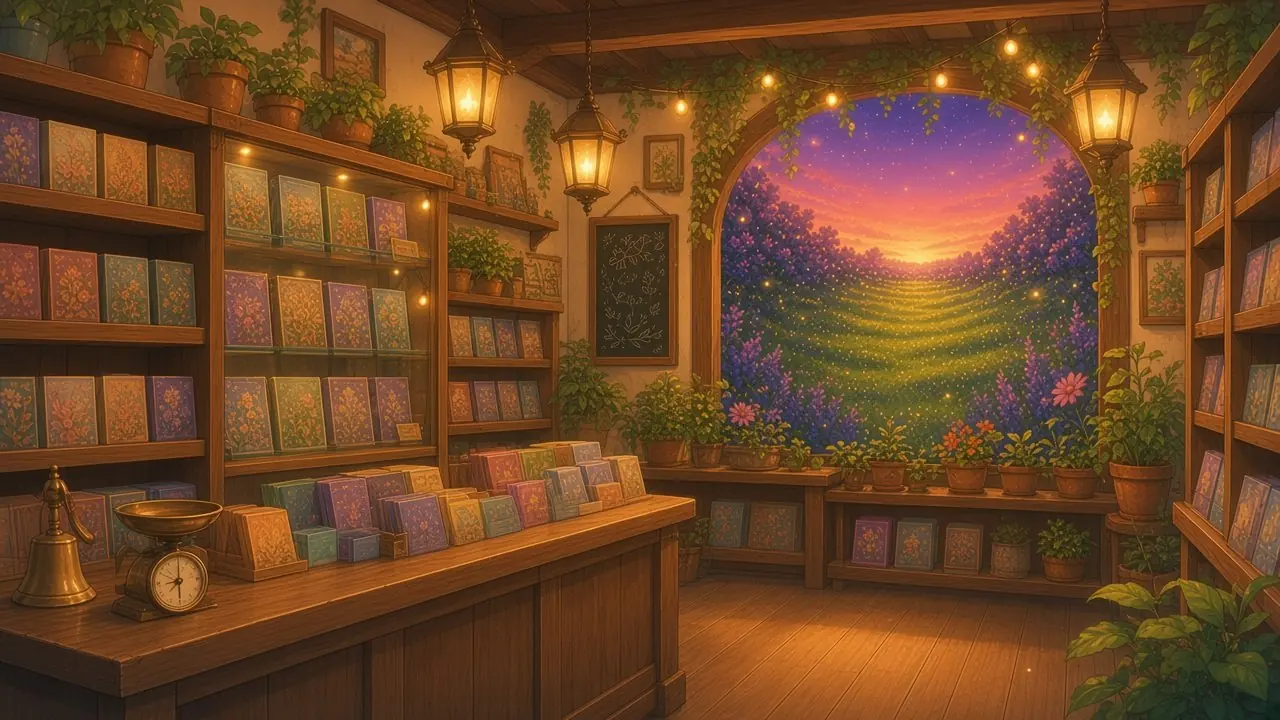
The Petal & Pocket shop interior.

Link to this post #Back to top ↑

DEVLOG #05 ·

Meet Wick, Our Lantern-Bearer

Wick, the dusk-firefly courier who guides new players.

Our first tutorial did its job. It walked players through roots, rank and power, and a rules guide was always one key press away mid-match. But watching people play, we noticed their eyes didn't always know where to look. A card game with a living board has a lot going on, and we wanted learning Thorncourt to feel as warm as playing it.

So the tutorial got a full refresh, and the game got a guide. We sketched a few mascot ideas and fell in love with one right away: Wick, a dusk-firefly courier who carries a court lantern. He's purple and gold, his tail glows, and he's always got a message bag slung over his shoulder. Wick tends to show up exactly when you need a little light.

In the new tutorial the screen gently dims and a soft glow ring spotlights exactly what matters: the tile you can play on, the card you're about to place, the lane you're winning. Wick pops up beside it with a short note, pointing the way. The core lesson is shorter and better paced than before, and optional advanced lessons are there for anyone who wants to dig deeper.

Wick doesn't retire once the tutorial ends. He shows up with friendly first-time tips around the game, and his little portrait appears on hover tooltips for the match screen, so help is never far away. If you'd rather explore on your own, you can turn tips off at any time.

Wick quickly became the face of the whole game. He even ended up on our store art, flitting through the courtyard with his lantern held high.

One of Wick's first-time tips, explaining a special tile mid-match.

Link to this post #Back to top ↑

DEVLOG #04 ·

A Name, a City and a Rival

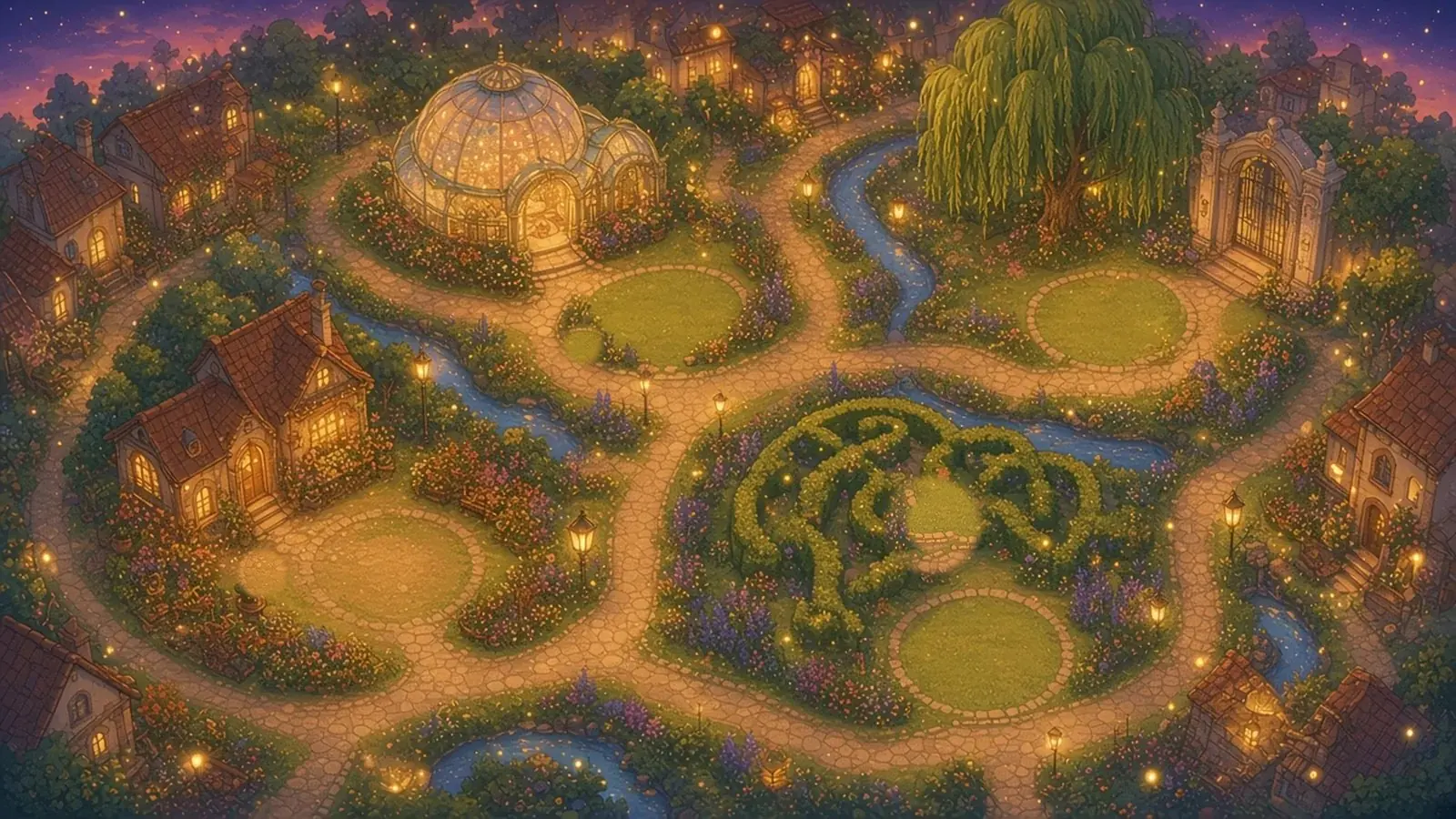
The Thorncourt Circuit: Greenmantle and its four venues.

On November 10 our working title retired, and the game became Thorncourt. The name came from the place we'd started imagining at the top of the league: a royal courtyard beneath a great willow, where the best players in the land come to duel.

With a name came a world. Thorncourt's career is now the Thorncourt Circuit. You're a newcomer in Greenmantle, a garden city where card duels settle everything. Each cup has its own venue on a hand-painted map. The Seedling Cup is played at Petal & Pocket, a cozy card shop full of lanterns and decks. The Bloom Cup moves to the Everbloom Conservatory, a greenhouse arena under a great glass dome. The Thorn Cup winds into the Briarwind Maze, a midnight hedge maze where the lights grow fewer. And the Crown Cup ends at the Thorncourt itself, where Elder Willow guards the throne.

Every story needs a rival, and ours is Wren Ashgrove, "The Tally Keeper." Wren arrived in Greenmantle the same morning you did. She's loud and competitive, keeps a pencil-and-notebook tally of every duel, and carries her grandmother's old cards, while secretly worrying she isn't good enough. You'll face her once in every cup, and the cup's boss stays locked until you beat her. By the time you reach the throne, she's the one cheering loudest.

To tell that story we added twenty short, fully skippable scenes along the Circuit, painted backgrounds for each venue, and a champion ending waiting at the top. Around the same time we added a short Wildfruit Studios splash when the game starts. It's a small thing, but seeing our own logo pop up the first time was a lovely moment.

The next day Thorncourt got its own little home on the web at thorncourt.wildfruitstudios.com, with the Circuit, the rival, the card styles and how to play, all in one place.

Wren Ashgrove, ready for one last duel on the Thorncourt steps.

Link to this post #Back to top ↑

DEVLOG #03 ·

Twenty Trainers and a Wardrobe of Styles

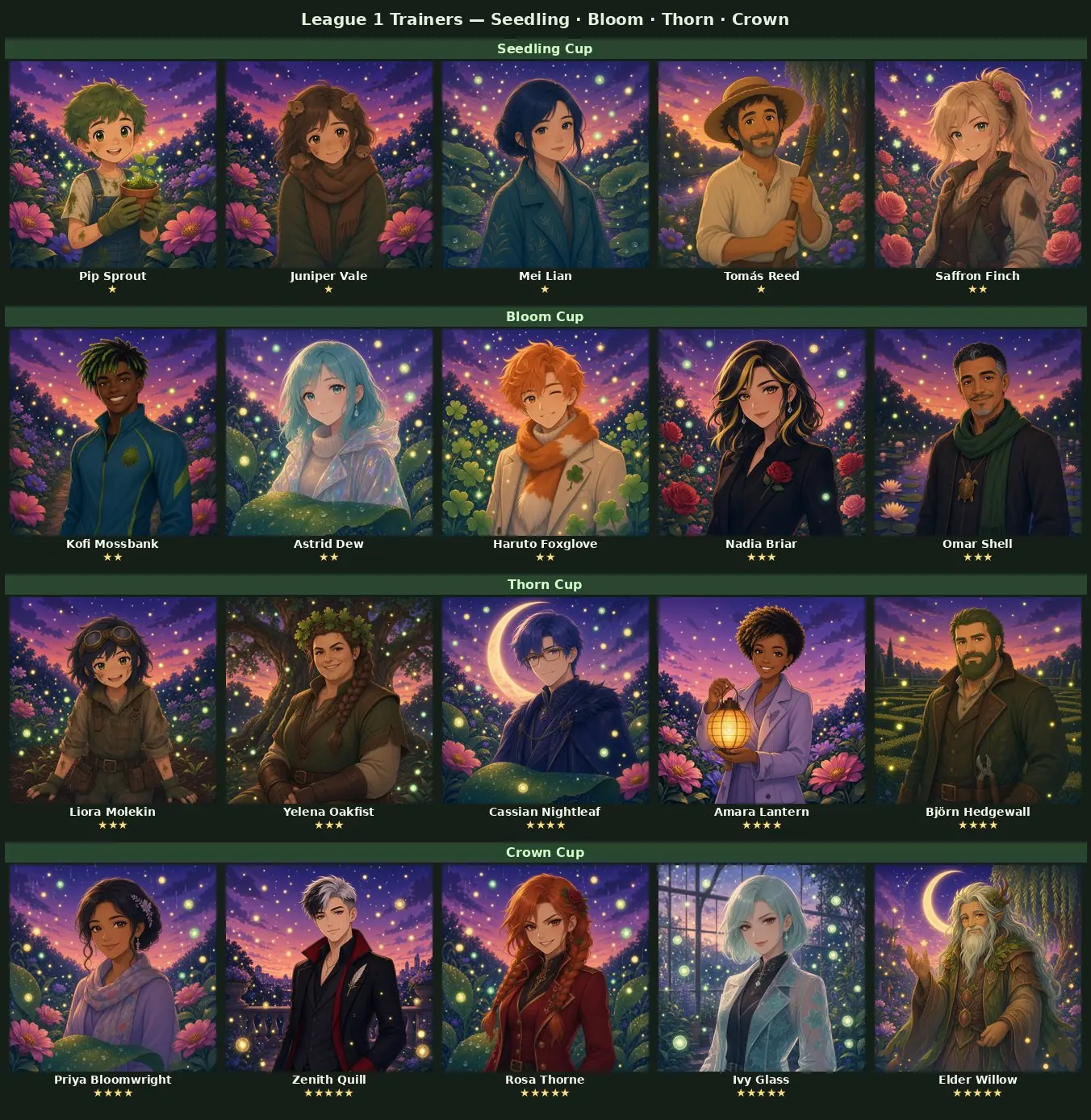
The twenty trainers of the first league, from Pip Sprout to Elder Willow.

A few tournaments were fun, but we wanted something to climb. So we built a full career league: twenty named trainers, each with their own portrait and a deck that gets tougher as you go. They're split into four cups of five: the Seedling Cup, the Bloom Cup, the Thorn Cup and the Crown Cup. Each cup unlocks the next, and beating all twenty makes you League Champion.

Your first opponent is Pip Sprout, a cheerful kid with a potted seedling and a big heart. Waiting at the very end is Elder Willow, the oldest and wisest player in the league. Every first win against a trainer earns a unique reward card, so the climb grows your collection as well as your trophy case.

At the same time, we started dressing up the cards. Thorncourt has card skins: alternate art styles you unlock in the shop with credits you earn by playing. You can buy a whole set or one card at a time, mix styles card by card in a single deck, and one skin covers every copy of a card you own.

The first new styles arrived quickly. Surrealist is dreamy and strange, with floating islands and impossible skies. Wildborn reimagines each creature as an animal-eared hero. Nightbloom is a bold, midnight look in black and red. Ronin brings ninja and samurai grit, and Shounen goes big and bright with glowing auras and speed lines.

We loved how much a new style could change the mood, so we went further. The menus, title screen and board can follow your deck's style, or you can pick your favorite look for each one in Settings. Swapping a deck from Cozy to Nightbloom feels a little like walking into a different tea house.

We rounded out this stretch with some comfort features: up to four player profiles on one computer, each with its own collection, decks, career and themes, plus proper fullscreen and windowed modes that remember your choice.

One card, many moods: Clover Fox in six of its styles.

Link to this post #Back to top ↑

DEVLOG #02 ·

A Board You Can Actually Play

The first set of card art, now the default Cozy style.

Once the rules were steady, we gave them a home. The first playable version was simple pass-and-play: two people sharing one computer, taking turns on the garden board. Right away we added a small kindness for that setup. When it's your turn, the game hides your opponent's hand until they press Ready, so nobody peeks.

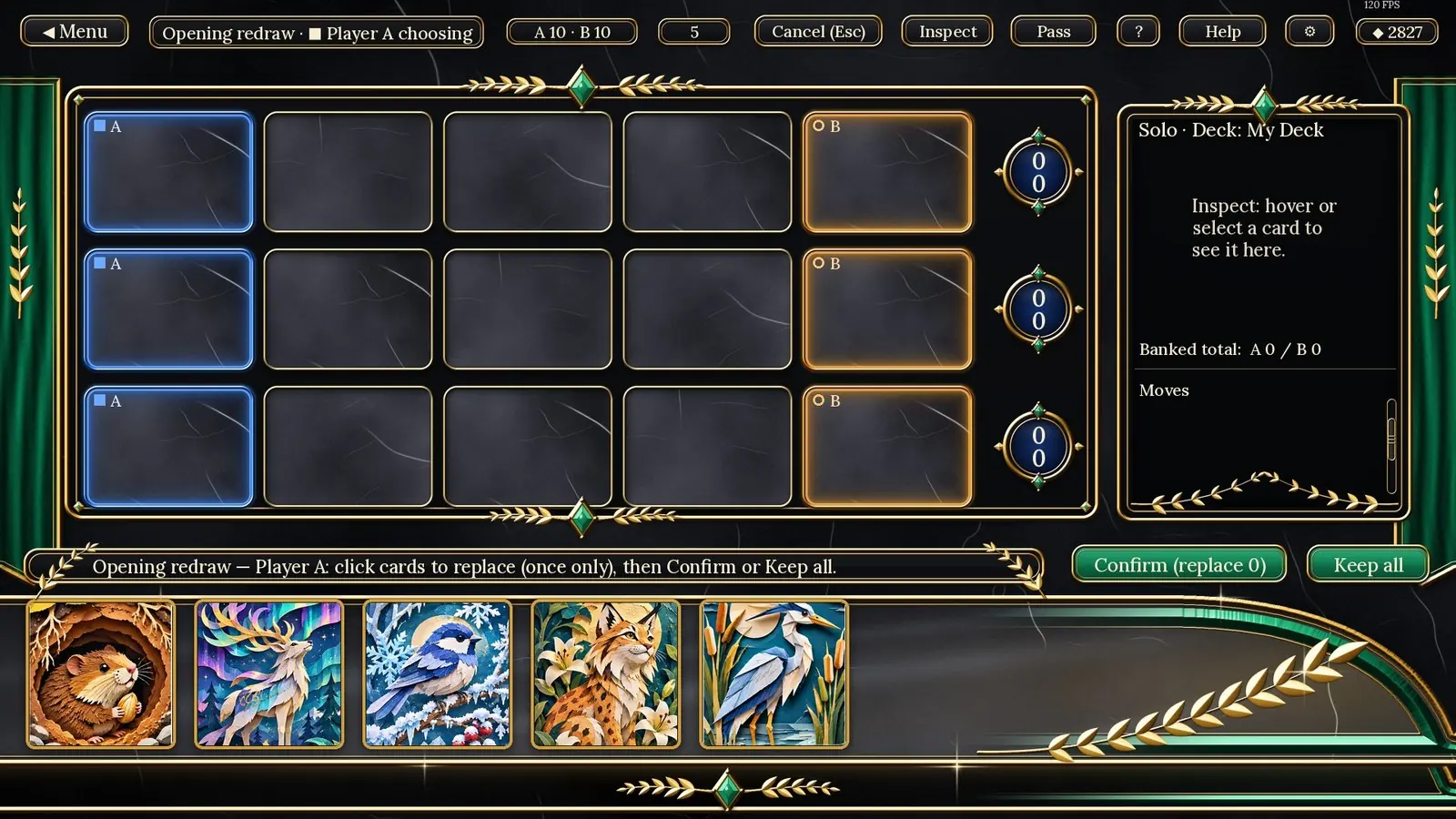
Next came the opening-hand redraw. At the start of a match you can pick any cards from your first hand to swap out, once, or simply keep them all. It's a tiny moment, but it takes the sting out of an unlucky start.

We always wanted Thorncourt to be great to play on your own, so a computer opponent was next on the list. Our goal wasn't a sneaky machine that bends the rules. It plays by exactly the same rules you do, sees only what a player would see, and tries to make good moves.

Then the game started to feel like a real collection. We built a Deck Builder for making your own 15-card decks, credits earned from playing matches, and a Card Shop to spend them in. Early tournaments with champion opponents and trophies followed, and your progress now carried over between play sessions.

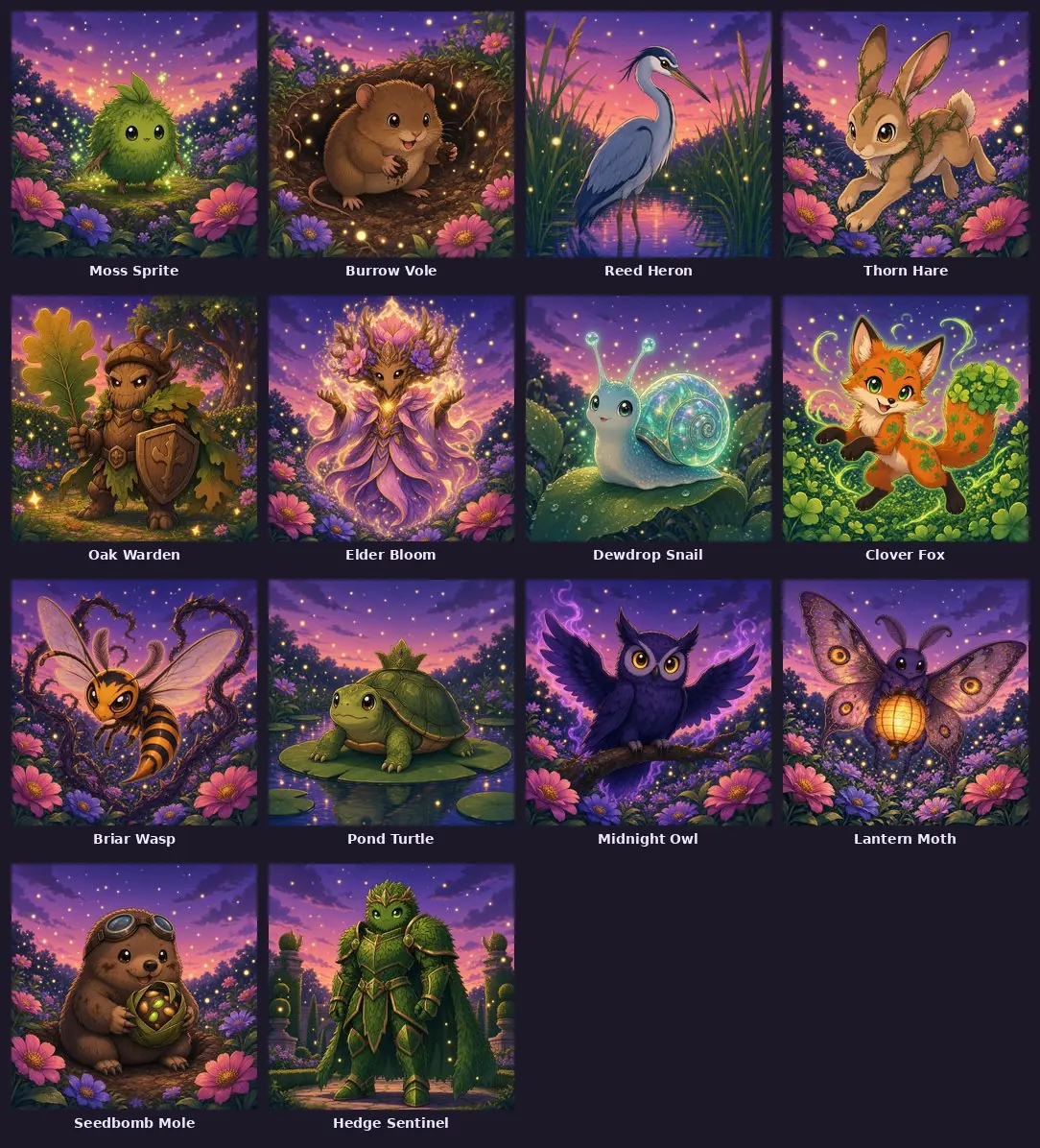
Then the cards learned some new tricks. We added the first abilities: Flourish, which strengthens nearby allies; Wither, which weakens nearby enemies (a card worn down to zero leaves the board, but the tile and its roots stay yours); Last Bloom, which rewards allies when a card is lost; and Crown Spur, which adds bonus points when its lane is won. Keen and Root Surge joined them later. Three new creatures arrived to show them off: the Lantern Moth, the Seedbomb Mole and the Hedge Sentinel.

Finally, the game got its first faces. Moss Sprite, Burrow Vole, Reed Heron, Thorn Hare and friends got their first painted card art, all twilight skies, fireflies and flowerbeds. That set became the game's default look, which we now call Cozy. We also added sound effects and gave the board a garden makeover with readable pattern grids on every card, a bigger board, and a slim side panel to inspect cards and follow the move log.

Link to this post #Back to top ↑

DEVLOG #01 ·

Planting the First Seed

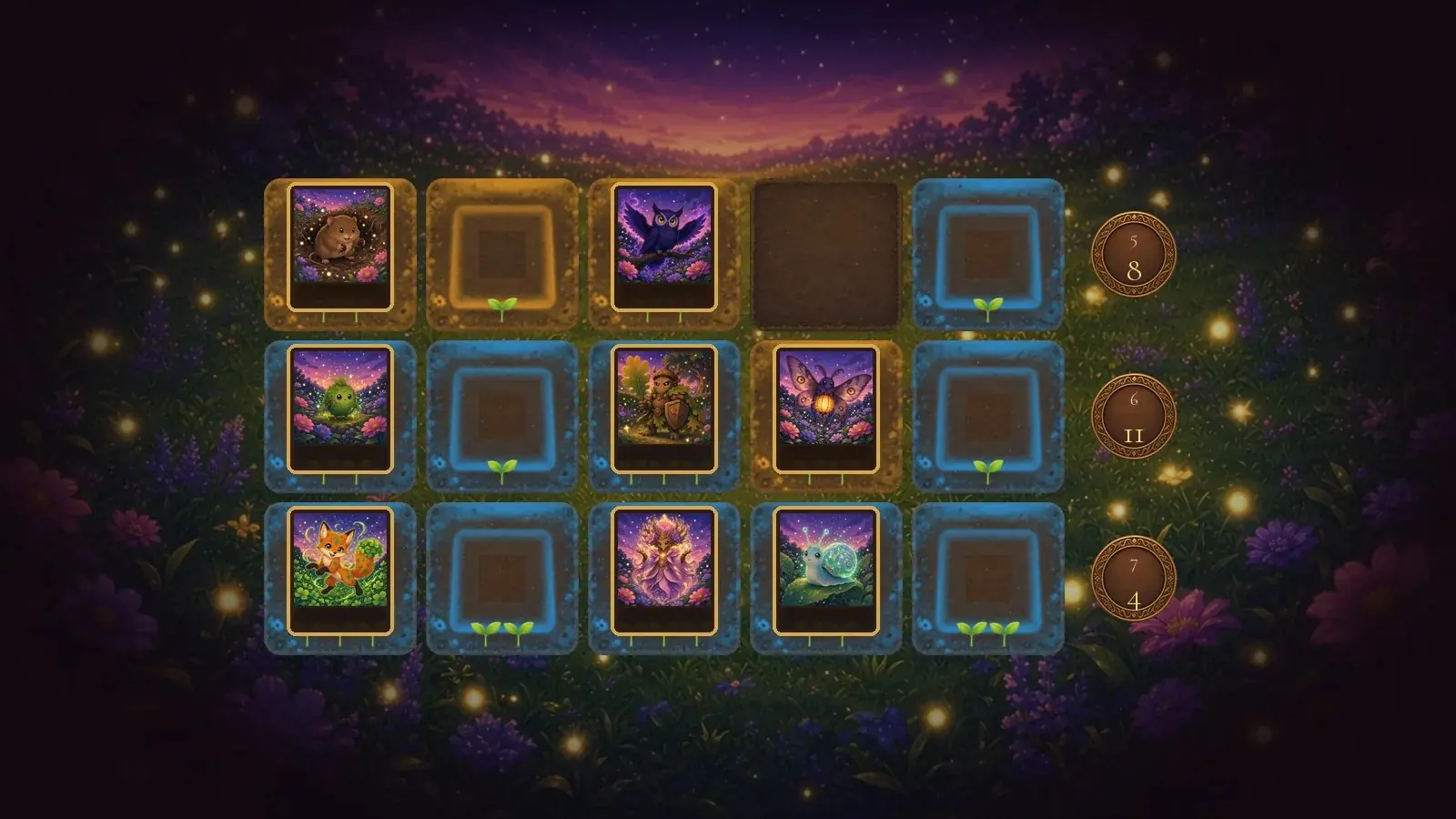
The 3-by-5 garden board, drawn from game art: three lanes, five columns, and roots that stay put.

Thorncourt didn't start with a name, a mascot or even a single picture. It started with a question we kept coming back to: what if a card game felt like tending a garden? Not just playing cards at an opponent, but growing your claim one tile at a time until the board itself tells the story of the match.

We spent the first day sketching out the core ideas. A small board, three lanes wide and five columns long. Each side starts with a narrow strip of soil. Tiles hold roots, from one to three, and a card's rank is how many roots a tile needs before you can plant that card there. The important twist is that roots are never spent. They stay in the ground, so every play you make shapes the plays you can make later.

When you play a card, its root pattern spreads across the board. Empty ground becomes yours, your own soil grows richer, and sometimes an opponent's empty tile flips to your side. When both players pass, each lane goes to whoever has more power in it. Win the lanes, win the match.

Back then the game had a plain working title (TerritoryCards, which says exactly what it is and not much else) and a gentle garden theme we weren't even sure we'd keep. We picked a game engine that suited a light, 2D game. Then, before drawing anything at all, we built the rules on their own: six simple starter cards, 15-card decks, turns, root spreading and lane scoring, all checked by an automated test suite so we could trust them.

That might sound like an unusual way to begin a cozy game, but it gave us something precious: a set of rules we could rely on completely. Every match plays out the same way given the same moves, which made it easy to spot mistakes, replay tricky situations, and later teach a computer opponent how to play fairly.

By the end of day two there was nothing to look at yet, just a quiet set of rules humming along underneath. But the seed was in the ground.

Link to this post #Back to top ↑

Imagery is from Thorncourt in development and may change before release.